Rest, surrender, dream-space
Waning Crescent: the last hush
The Waning Crescent lowers the lights and asks you to stop holding everything so tightly.
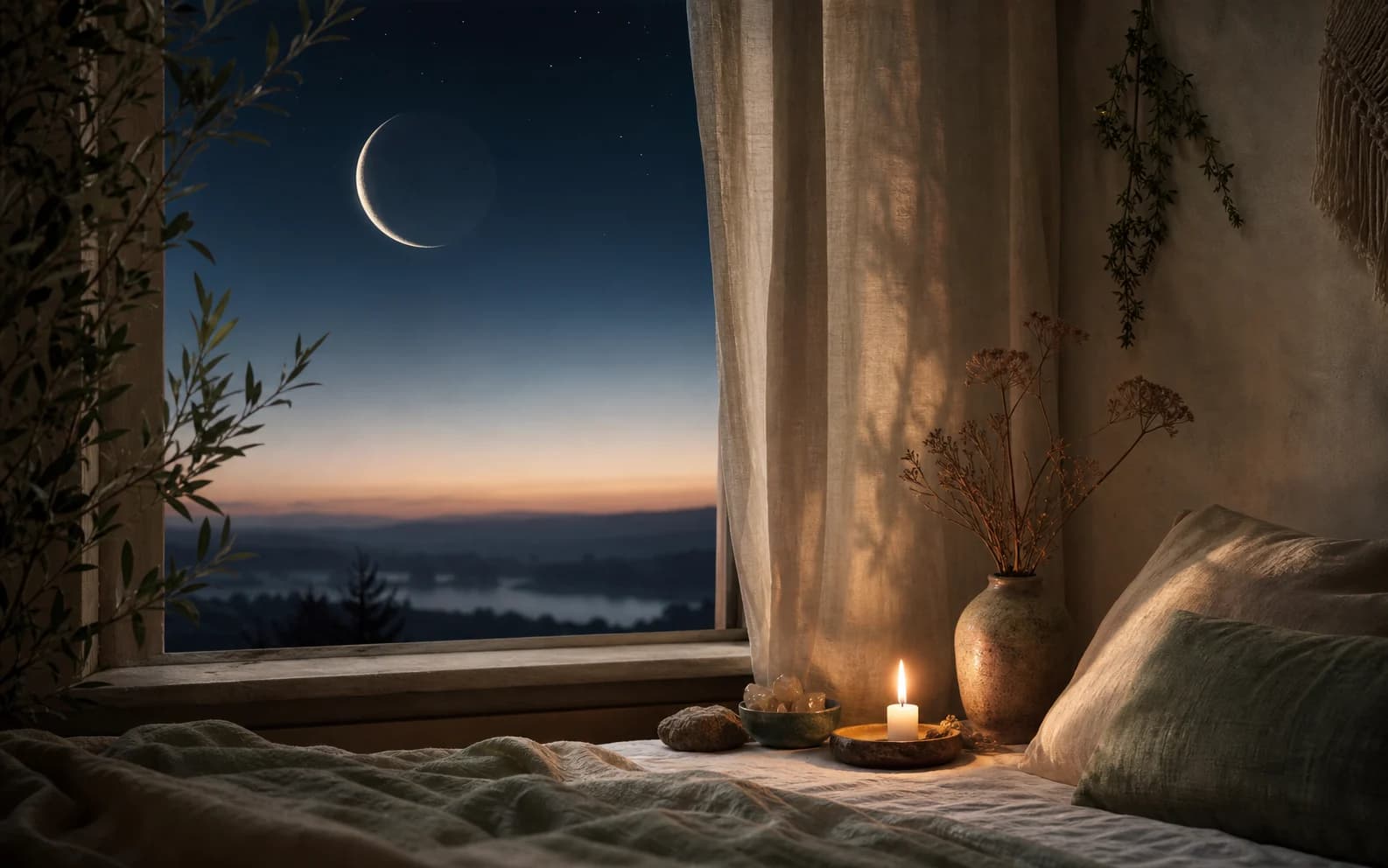
The moon lowers its voice
The Waning Crescent is the last thread of light before the moon goes dark again. It feels like a bedroom window before dawn, curtains moving slightly, the world not awake yet.
This phase belongs to the exhale. The cycle has been bright, active, revealing, clearing. Now it becomes quiet. You may feel slower here, more porous, more aware of what your body has been carrying.
Why only a silver hook remains
The Waning Crescent appears when the Moon is nearing the Sun again in the sky. Only a thin slice of the sunlit side is visible from Earth. In the Northern Hemisphere, the bright curve usually rests on the left, delicate and low, often easiest to notice before sunrise.
It is a beautiful phase because it feels like almost nothing and still something. The Moon is not gone yet. It is offering the last visible thread of the cycle, a small light before the dark reset of the New Moon.
This phase is made by the same simple geometry as the rest of the cycle: the Moon keeps orbiting Earth, and from our view the sunlit portion narrows night by night. The visible light is not dying. It is turning away. That distinction matters when you are learning to let something end without treating the ending as failure.
The dawn moon
The Waning Crescent often belongs to the early morning. It may appear in a pale sky while the world is not fully awake, a curved piece of silver above rooftops, trees, or the quiet edge of a commute. It feels more like a whisper than a signpost.
That dawn quality gives the phase its softness. It is not the dramatic darkness of midnight. It is the thin place between sleeping and beginning again, when dreams are still close and the day has not yet asked you to be useful.
Dreams, softness, and unfinished feelings
Waning Crescent energy often lives in the half-lit places: dreams, memory, the song that stays with you, the old feeling that appears for a moment and then dissolves. It is not always a moon for answers. It is often a moon for gentleness.
In love, this can mean forgiving what is ready to soften, or simply no longer rehearsing a conversation that has taken enough from you. In creativity, it may mean stepping back so the next idea can arrive without being chased.
Rest as an actual practice
This moon can expose how uncomfortable rest has become. You may reach for one more task, one more explanation, one more bit of proof that you deserve to stop. The Waning Crescent quietly refuses that bargain.
Rest here is not laziness dressed up as spirituality. It is maintenance. It is nervous-system repair. It is the soil being left alone long enough to become ready again. If you keep digging for a new beginning before the old cycle has decomposed, even good ideas can arrive tired.
The energy of being allowed to fade
Not every ending needs to be analyzed until it becomes useful. Some things simply need to fade. The Waning Crescent gives permission for that softer kind of closure: less explaining, less gripping, less trying to turn every feeling into a lesson before it has rested.
This phase can make you more aware of dreams, sleep, old memories, and subtle emotional weather. It is often a good time to reduce noise. Fewer tabs. Fewer demands. Fewer conversations that ask more from you than you have available.
The kindness of not knowing yet
Near the end of the cycle, the mind may want to hurry into meaning. What did this month teach me? What comes next? What am I becoming? Those questions are useful, but not always on command. The Waning Crescent protects the space before the answer.
You are allowed to be between stories. You are allowed to feel done without feeling ready. You are allowed to let the old light fade and trust that the next beginning does not need to be dragged into the room early.
The clean edge of sleep
There is a reason this phase pairs so naturally with dreams. Near sleep, the mind stops arranging everything into straight lines. Images loosen. Memories drift closer. A feeling you ignored at noon may appear at the edge of a dream with no argument around it.
If you keep a notebook nearby, use it gently. Do not interrogate every symbol. Write the fragment, the color, the sentence, the person who appeared, then leave it alone for a while. Waning Crescent wisdom often arrives like mist: it disappears when grabbed, but it can still dampen the ground enough for something new to grow.
End gently
Lower the lights. Put fewer things on the list. Drink water. Sleep. Write down one thing you are done carrying for tonight and let the page hold it.
The next New Moon will come. For now, the Waning Crescent offers the grace of not beginning yet. There is a kind of wisdom that only enters when the room is quiet enough.